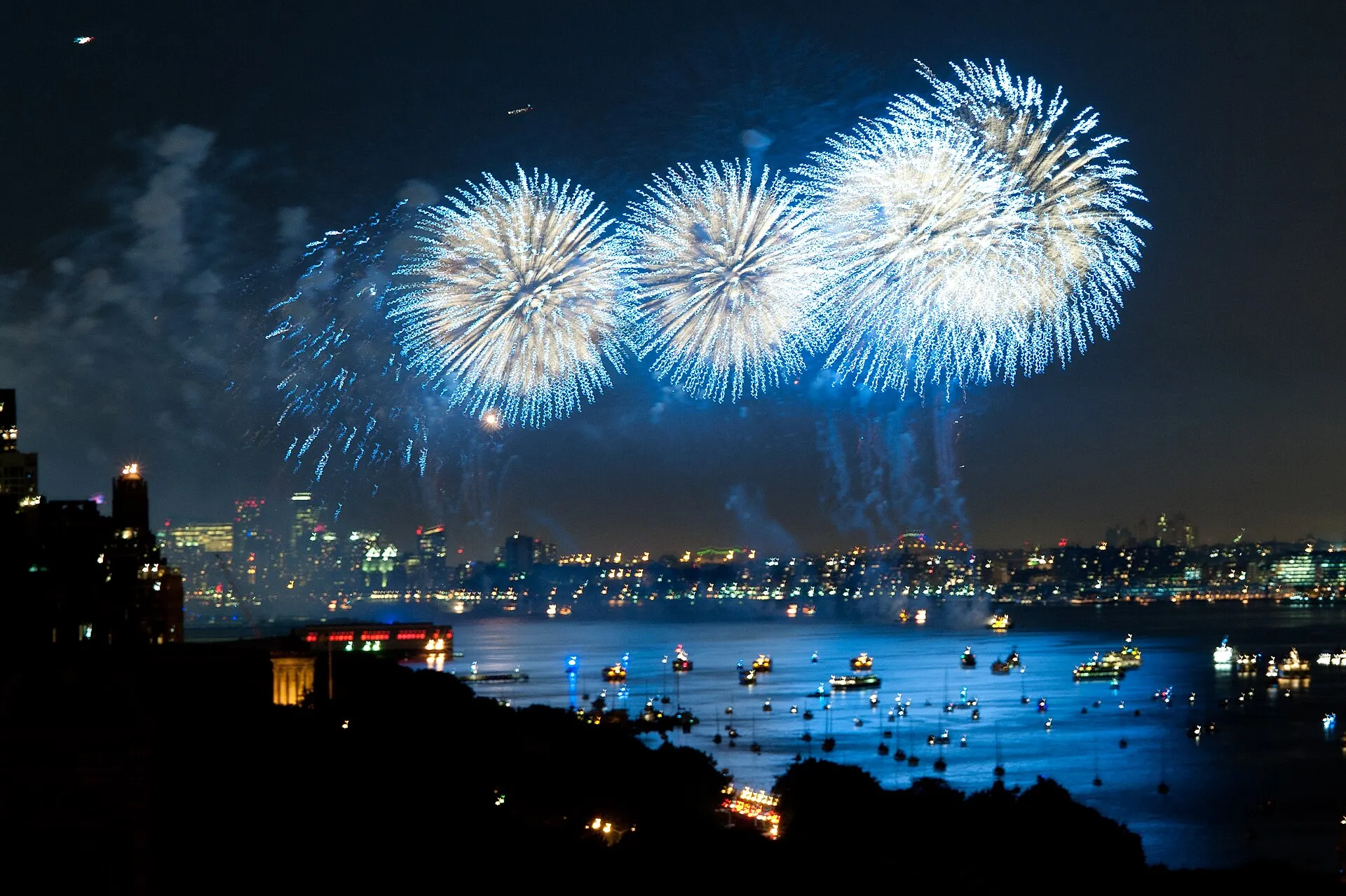
On the twentieth of August the embankment is so packed that you do not have to decide which way to go: the crowd carries you.
I came with my friends, but ten minutes before the fireworks I lost them. There is nothing unusual in that — at times like that everyone loses everyone.
I stopped at the railing, where there was a hand’s width of space. Beside me stood a man who was also alone, and who was also pretending that this was fine.
The fireworks lasted ten minutes. I did not watch them to the end. At times like that people look up, and the city disappears — I looked at the water instead, where the lights appeared before they appeared in the sky.
“Everyone’s looking up,” said the man beside me. “Why are you looking down?”
“Because down there you see it twice.”
That was the only sentence we exchanged in ten minutes. Then it was over, the crowd turned round, and everyone started towards the bridge at once.
The crowd swept us away from each other. It was not dramatic: just one wave, one step, and I could not see him.
I thought that was that. On evenings like that a person thinks about somebody for three seconds and then goes home.
But on the bridge, where the crowd had thinned, I stopped, because I did not want to go home yet. I sat down at the foot of the railing and looked at the city, still humming.
Five minutes later he appeared.
“I wasn’t following you,” he said. “It’s just that everyone comes this way.”
I laughed.
“Sit down,” I said. “There’s room.”
His name was Máté. He worked in a bookshop in the city, and that evening he had come with his sister, who had already gone home.
“You?”
“I came with my friends, whom I lost.”
“That’s the custom at this time.”
We talked. Not much, but enough. About how the twentieth of August is always the same, and how that is not a bad thing, because there is one day when the city allows itself not to be serious.
“Do you like this city?” he asked.
“I don’t know. I always want to leave, and I never do.”
“I left once,” said Máté. “For two years. Then I came back, and I was surprised that I had missed the noise.”
There were fewer and fewer people on the bridge. The litter did not disappear — at times like that it stays until morning — but the lights faded, and the river went black again.
“I’m working tomorrow,” he said.
“So am I.”
Neither of us stood up. That was the best thing about that evening: that the two of us did not hurry.
In the end, around two in the morning, we set off. In the same direction, for three streets. At the fourth we parted.
“Well,” said Máté. “Thank you for those ten minutes.”
“It was more than ten minutes.”
“Yes. But I think that’s how you have to start.”
He did not ask for my phone number. He did not ask for anything else. He said:
“If you ever come into the bookshop where I work, you’ll recognise me.”
“And if I don’t come in?”
“Then it was still good.”
He left. I stood on the corner and watched him disappear.
Two weeks later I went into that bookshop. Not because I had decided to. But because I was passing, and I remembered.
Máté was at the till, and when he saw me he was not surprised.
“It’s been a beautiful summer,” he said.
“It has,” I said. “What do you recommend?”