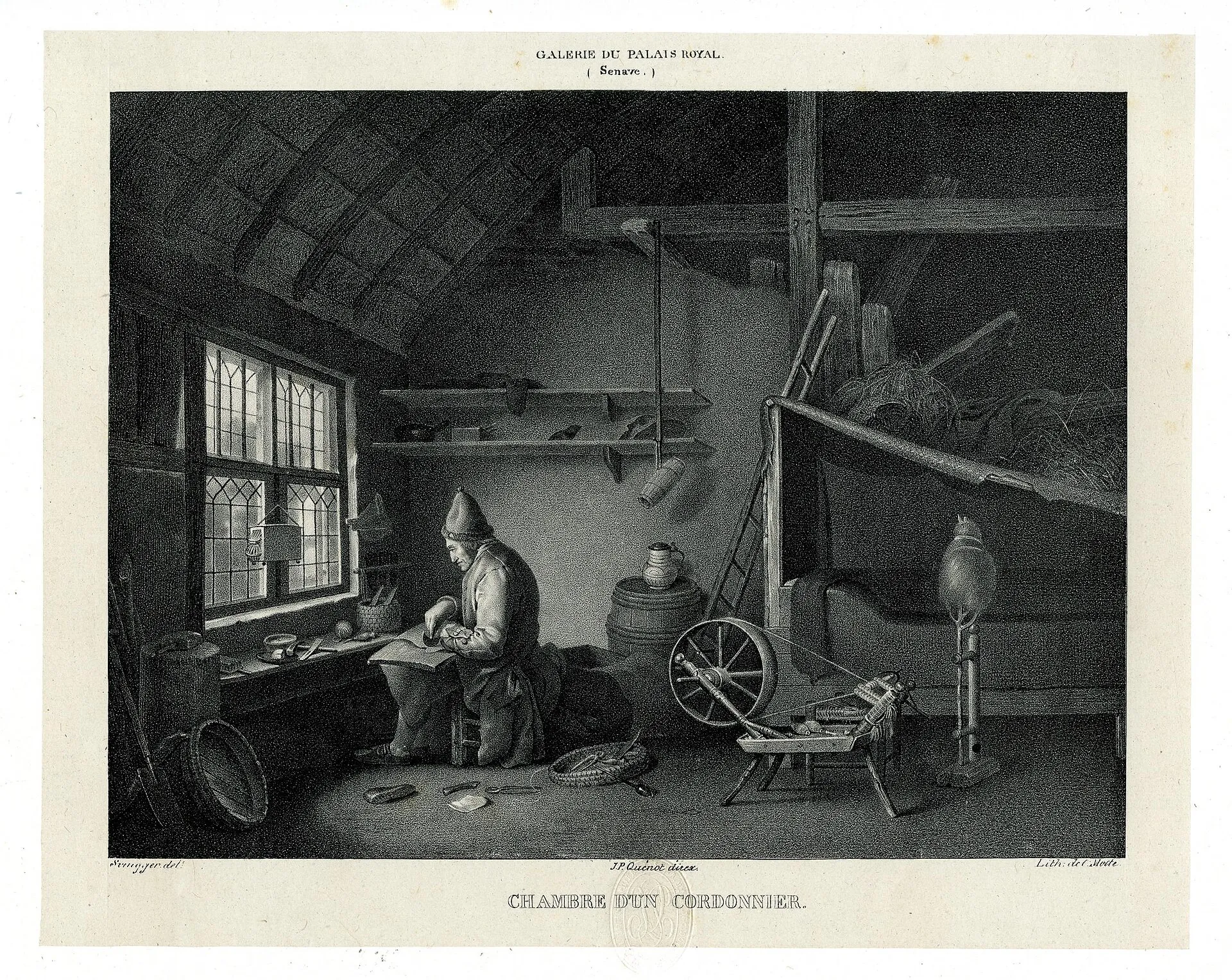
Once there was a shoemaker who worked honestly, and still grew poor.
He was not lazy, and he was not a bad craftsman. There was simply never enough work to live on.
In the end there was only enough leather left in the workshop for a single pair of shoes.
In the evening the shoemaker cut the leather out on the table and went to bed.
In the morning, when he came down to the workshop, the shoes were finished.
They were so beautiful, so neat and so strong, that the shoemaker rubbed his eyes.
In the afternoon a customer came in, looked at the shoes, and paid so much for them that there was leather enough for two pairs.
That evening he cut out the leather for two pairs and went to bed.
By morning both pairs were finished.
And so it went on: four pairs, then eight, then so many that the shoemaker could have taken on an apprentice.
The shoemaker grew rich, and the workshop filled up with fine shoes.
One evening, when Christmas was coming, he said to his wife:
“Let us stay up tonight. I should like to see who is helping us.”
His wife nodded and lit a candle.
Then they hid behind the curtain and waited.
At midnight the door opened.
Two tiny, naked elves came into the workshop.
They sat down at the workbench and began to work.
Their fingers moved so quickly that the shoemaker could hardly follow them.
By the time the sun rose, every shoe was finished, and the elves had vanished.
His wife said:
“These little men have made us rich. We must thank them.”
“How?” asked the shoemaker.
“We will make them clothes,” said his wife. “A shirt, a little coat, a waistcoat and trousers. And you will make them shoes.”
And so it was: his wife sewed the little clothes, and the shoemaker made tiny shoes.
On Christmas Eve they did not put leather out on the table, but the clothes.
Then they hid behind the curtain again.
At midnight the elves arrived.
They saw the clothes and stopped all at once.
They put on the shirt, the coat, the waistcoat and the trousers, and pulled the shoes onto their feet.
Then they began to dance about the workshop and to sing, because they were happy.
They skipped out through the door and never came back.
The shoemaker and his wife looked into the empty workshop for a long time.
But the shoemaker never had to worry about making a living again, and every evening he closed the workshop door with thanks in his heart.